Real Estate Intelligence Terminal at city scale.
Research-grade tools for urban real-estate decision-making — live financial modelling on entire cadastral inventories, original urban-network metrics, and applied algorithms for city-service distribution. Built on the Mesh City doctoral framework, Silesian University of Technology.
Mesh Index Terminal
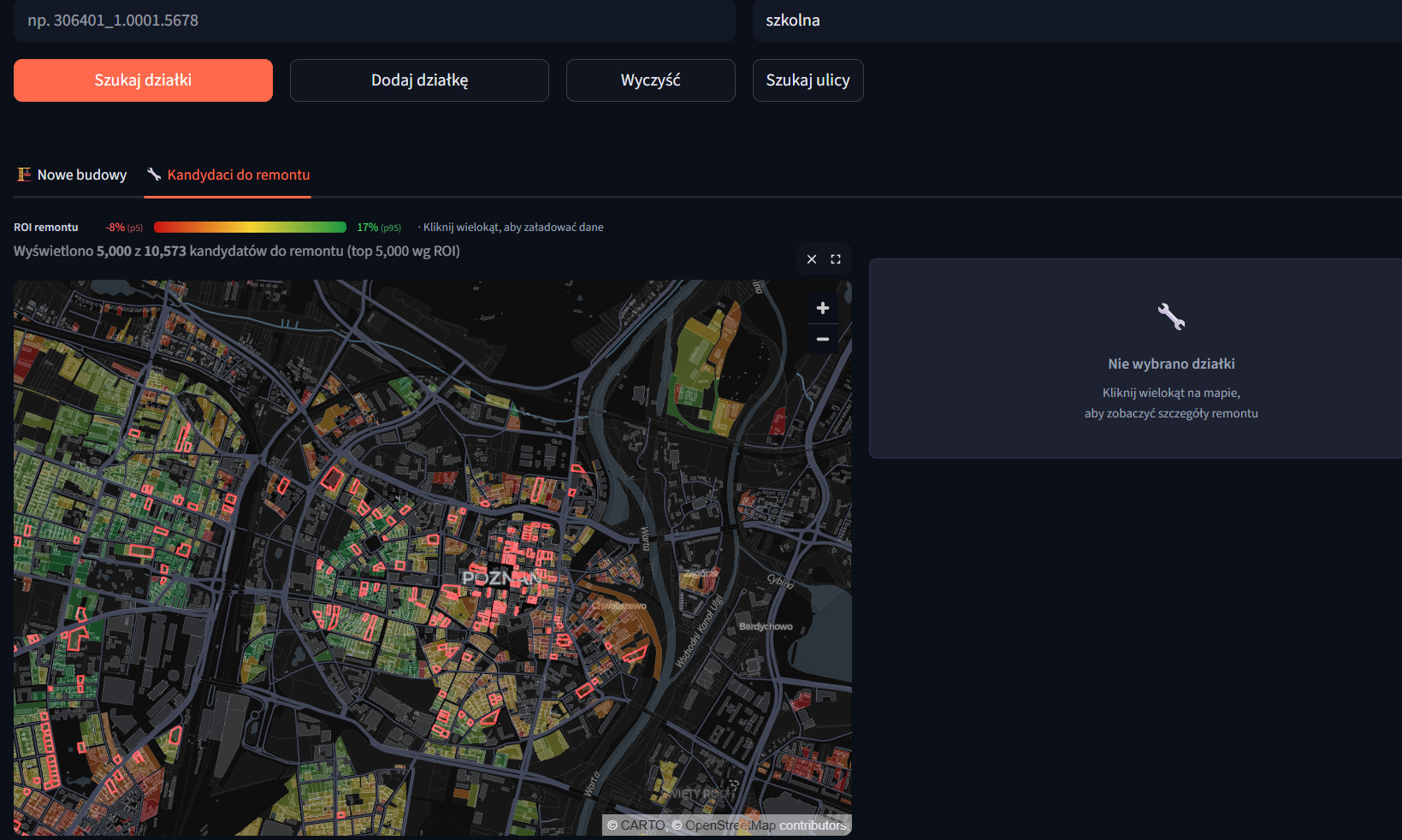
Finds the parcels where redevelopment economics and planning constraints actually align — infill, rebuild, reuse. A city-scale screening engine (over 70k parcels) that runs a full developer financial model — build, demolition, parking, financing, projected revenue — on every parcel simultaneously, then surfaces ROI-ranked candidates on a live map. 7 scenarios to choose, quick boot time under 90s. Live MPZP zoning overrides, heritage cost multipliers, registered transaction comparables, and an engineered parking-capacity model baked into every result. Transferable to any Polish city.
- Status
- Live · Poznań
- Coverage
- 78,450 parcels
- IP
- Patent pending (PL)
Mesh Index Studio
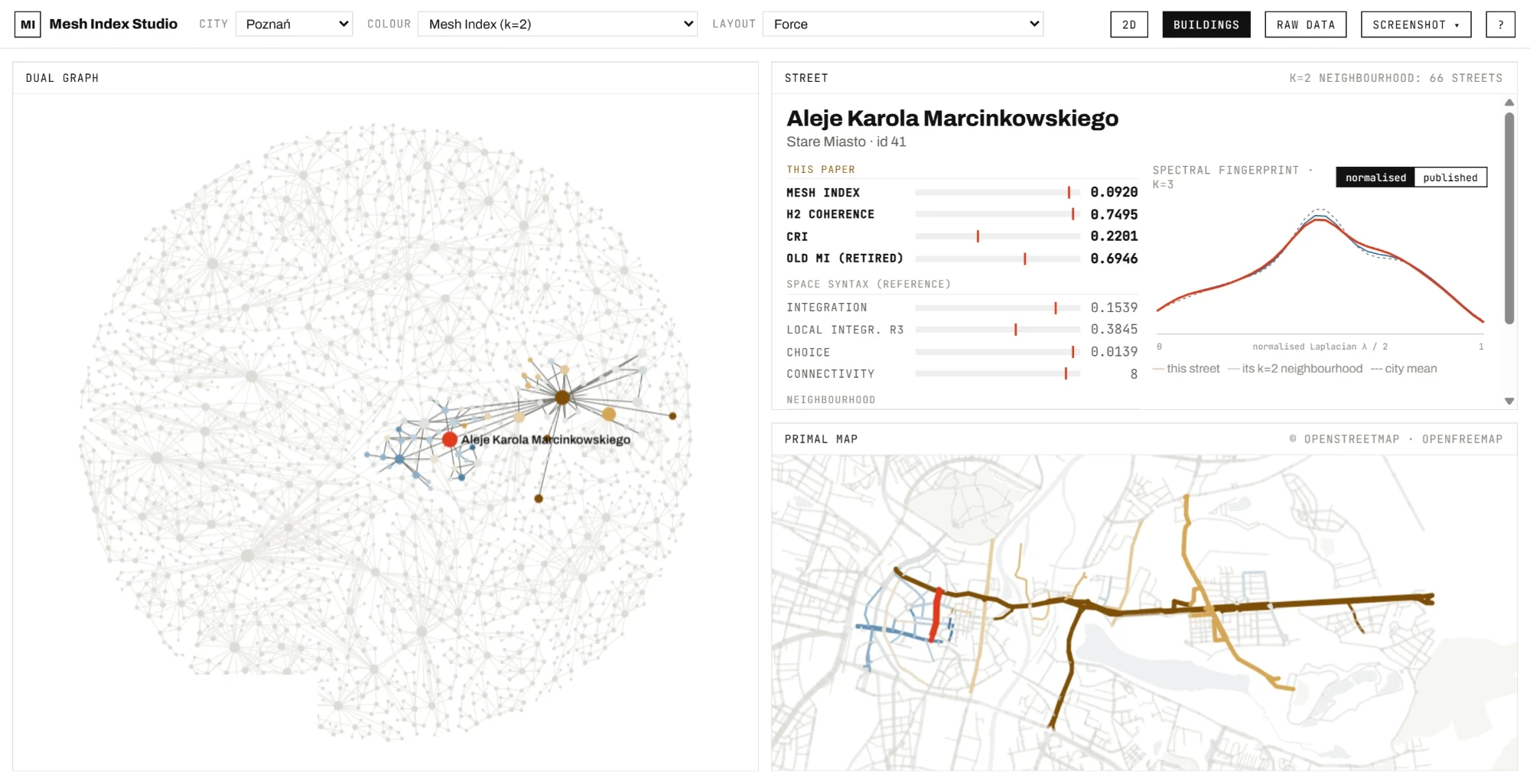
Interactive companion to Spectral Fingerprints of Street-Network Morphology. Every street becomes a node of the dual graph; select one to see its k = 2 neighbourhood in the graph and on the map, its Mesh Index, H2 coherence and CRI against the city distribution, and its spectral fingerprint. Classical space-syntax measures — integration, local integration, choice — run alongside as reference.
- Metrics
- Mesh Index · H2 · CRI
- Reference
- Space syntax
- Layouts
- Geo · Force · Spectral
- Cities
- 10, Poznań to Chicago
City Services
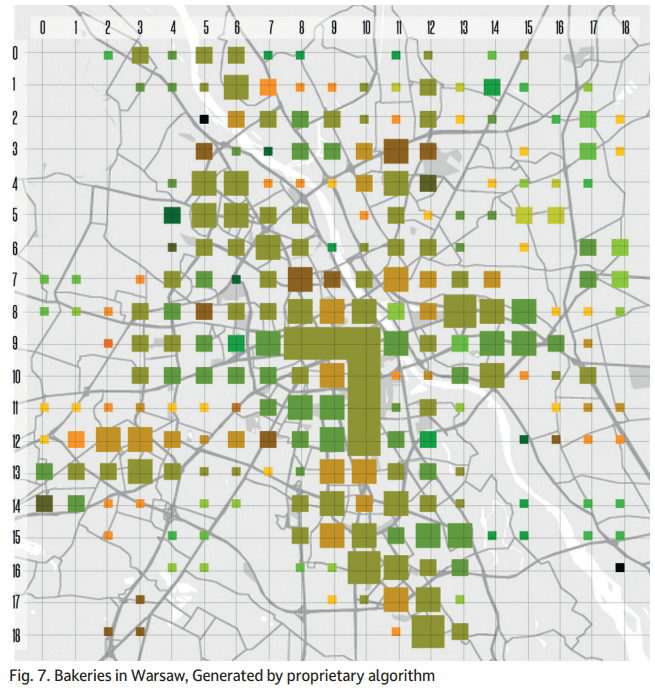
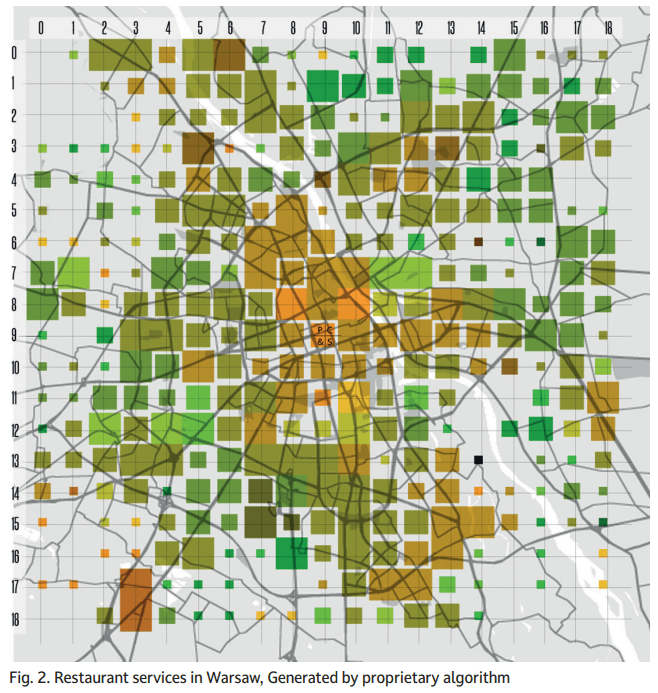
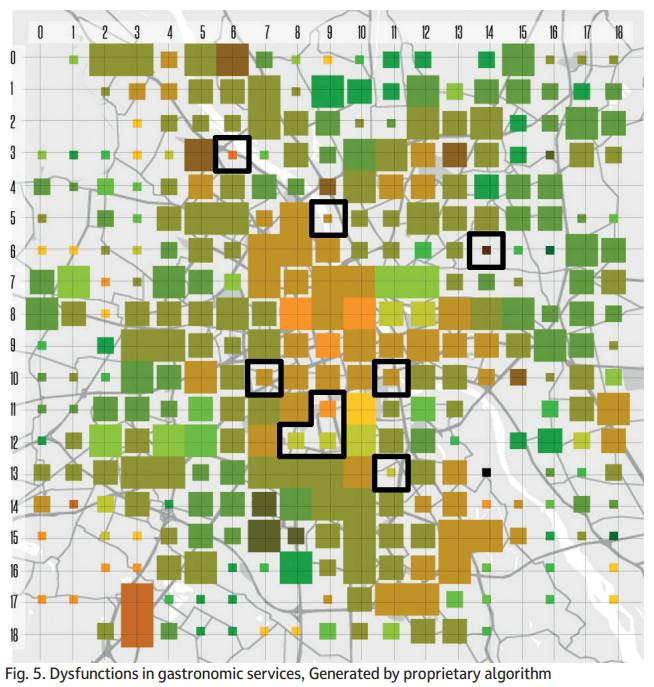
A proprietary algorithm for analysing the spatial distribution of urban services across a city's lattice by keyword — based on urban-platform big data. Hue encodes quality and price accessibility; size encodes choice range. Validated against Warsaw in the context of the 15-Minute City framework, published in Builder Science (2024).
- Domain
- Amenity distribution
- Validated
- Warsaw · peer-reviewed
- Computational urban morphology, applied graph theoryDomain
- PhD · Urban Science, Silesian University of TechnologyDegree
- National Board of Polish Architects Association — SARP ZGBoard
- Senior Urban Consultant · The World BankPractice
-
Under reviewSpectral Fingerprints of Street-Network Morphology: A Size-Adjusted Graph-Laplacian Descriptor of Urban FabricarXiv preprint ↗
-
Doctoral thesisMesh City — cyfrowa strategia analizy przestrzennej miasta w społeczeństwie sieciowym
-
Peer-reviewed articleAnalysis of Warsaw's Gastronomic Services Using Big Data in the Context of the 15-Minute City ConceptRead the publication ↗
Founded on published research.
Applied research and product studio at the intersection of urban science and real-estate development. Based in Poznań.
Piotr Kamiński, Eng. Arch., PhD — urban scientist, practising architect, strategic consultant obsessed with cities. Mesh Index originated in PhD research on network-society spatial analysis.